Lawrence Grey
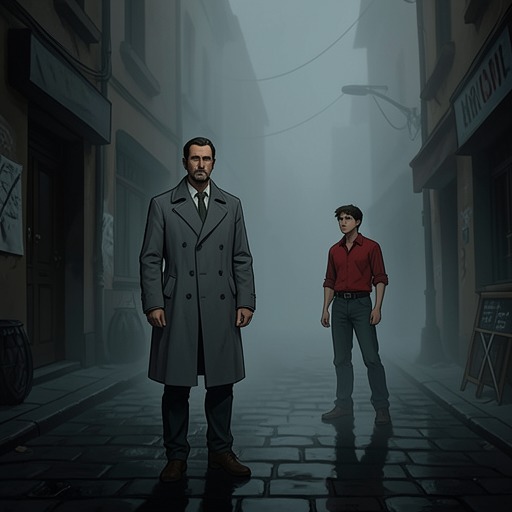
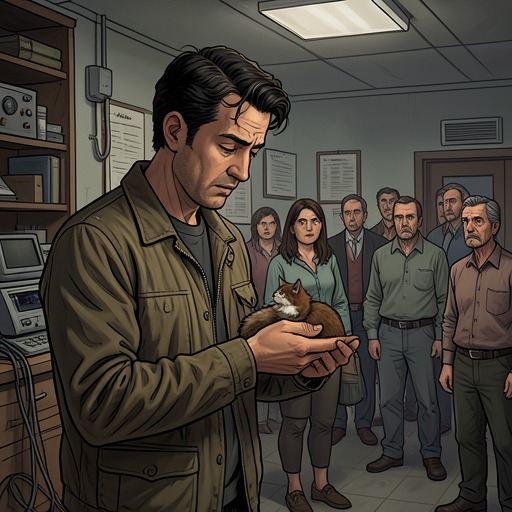
The Passage (Justin Cronin Edition)Lawrence Grey is a civilian sweep at the Colorado compound, assigned to watch Subject Zero from behind an infrared monitor. His account links the compound’s inexplicable prisoner to the compromised circumstances of Grey’s own release: he is not simply an observer of a contained threat, but a man living under a bargain that regulates his body, limits his movements, and keeps his past at a distance. The space between those forms of containment gives his perspective its unease.
Identity and Background
Grey works among the civilian sweeps and some technical staff housed in barracks at the south end of the compound. The arrangement offers cable television, hot showers, and no bills, along with good pay deposited in an offshore account. Its central condition is that the workers cannot leave for a year. Grey accepts the restriction partly because the money promises a future beyond the facility: he imagines saving enough to travel, first considering Mexico and then French Polynesia, whose blue water and stilt houses catch his attention on television.
The compound’s location is meant to be obscure, but Grey pieces it together from Colorado license plates and copies of The Denver Post. After a snowfall, while shoveling the barracks roof, he sees what appears to be a ski resort beyond the snowy trees, with a gondola climbing the hillside and tiny figures descending the slope. It lies perhaps five miles away. The nearby ordinary world remains visible, yet inaccessible; Grey can watch it from the roof without being able to go there.
The Compound and Subject Zero
Grey’s work gives him a prolonged view of Subject Zero through infrared surveillance. For six days, Zero stays in a corner without coming out to feed. On the monitor he appears as a glowing shape in the shadows, sometimes shifting several feet to one side or the other. Grey never sees the movement happen; he looks away to get coffee or sneak a smoke and finds Zero somewhere else when he looks back. The gaps in observation make a simple change of position feel like an impossible event, prompting Grey to wonder whether Zero is hanging, sticking, or levitating.
The captive’s appearance offers Grey no reassuring explanation. Zero has a head, eyes, ears, a mouth, arms, and legs, but these recognizable features do not make him legible as human. Grey’s attention settles on the mismatch between bodily resemblance and radical difference, while the facility offers him no information to close that gap. He has not been told what Zero actually is, or even why the captive’s behavior has changed.
Grey also wonders whether the other captives have stopped eating. He recalls the strange feeding pattern he has observed: when given ten rabbits, they eat nine and leave the tenth untouched. The unexplained remainder turns feeding into a question of ritual or rule, though Grey can only speculate about its meaning. His recollection of Brownbear, the dog who divided his food between morning and night, briefly places this unsettling behavior alongside an ordinary memory of a beloved pet; that association cannot explain the captives, but it shows Grey reaching for familiar patterns where official knowledge is absent.
Release, Treatment, and the Past
Grey’s arrival at the facility began with recruitment under strict controls. Two days after meeting unnamed recruiters, he flew to Cheyenne, where Richards collected him. Richards required Grey and the other men to surrender wallets, phones, photographs, anything written on, and even a bank pen. Their ride continued in a van that looked ordinary outside but had blacked-out windows and a sealed driver’s compartment. Inside, Grey met Jack and Sam, men who looked much like him. He gave his first name as Lawrence, a name he barely used, and felt as though the journey had made him a different person.
The arrangement was not an ordinary civilian job. Grey had been released from prison on the condition that he take a monthly Depo-Povera injection and a daily star-shaped spironolactone pill; he had followed the regimen for a little over six years. The medication reduced his body hair and the size of his testicles, softened his skin, and, more consequentially, dampened the feelings that once could torment him for days. Grey connects that altered emotional state to the crime that began his imprisonment fifteen years earlier, although the memory and its associated guilt now seem blurred and distant.
The regimen also shapes his daily habits. Depo makes him need to urinate frequently, and Grey avoids being seen around children, pregnant women, highway rest stops, and much of television. He is barred from coming within two hundred yards of a school or daycare center; he avoids driving between three and four and takes detours to stay away from school buses. These restrictions are not presented as incidental inconveniences but as the continuing terms of his release, governing where he can go and what he tries not to encounter.
Forgiveness and Self-Containment
Grey considers the medication better than prison and better than the life he had before it, when he felt like a bomb about to go off. He plans to continue taking it even after the court-ordered ten years end. That choice is not a declaration that he has reconciled himself to his past: it is a determined effort not to encounter what he calls the bad Grey again. The treatment gives him distance from violent impulse, but that distance also makes guilt less distinct, as though moral reckoning has been softened along with the feelings that might sustain it.
His prison psychologist, Dr. Wilder, had made forgiveness a constant subject, describing it as the first step on a long road of recovery and as a door through which Grey might face the bad self inside the good one. Grey distrusts the language and suspects Wilder repeats the same lesson to everyone. Still, he recognizes the force of its underlying distinction: for much of his life, he believes, the bad Grey was the only Grey there was. He imagines that his dead father might now be someone he could forgive, though the thought remains tentative rather than resolved.
The account sets Grey’s private containment beside the compound’s literal one. His employment gives him shelter, pay, and an imagined route to a future elsewhere; its rules keep him inside, while his treatment and self-imposed avoidances keep parts of his past and the outside world at a distance. At the same time, he is made to monitor a captive whose nature no one will explain. Grey’s practical, speculative voice can describe the glowing shape, the missing rabbit, and the blacked-out van, but none of these details gives him authority over the system that joins them. His life at the compound is therefore both a refuge he has chosen over prison and another enclosure whose terms are set by others.